By Richie Lennon
At a glance
Revised Entrepreneur Relief reduces Capital Gains Tax to 10% on qualifying business gains, up to a €1.5 million lifetime limit for disposals from 1 January 2026. The limit applies to gains, not the sale price. Earlier qualifying disposals count towards it. For company shares, the shareholding and working-time conditions have different timing tests. Check both before agreeing a sale.
The offer is one number. What you keep is another.
We see owners treat Entrepreneur Relief as the whole tax conversation at exit. It is often only the first part. A bigger offer can push more of your gain above the limit, while a change in ownership, role or group structure can change whether you qualify at all.
This is a conversation to have while you still have choices. If your accountant has quoted a 10% exit tax bill without checking your ownership history, your role and the proposed deal, that number is unfinished.

What is entrepreneur relief?
Revised Entrepreneur Relief is an Irish tax relief for individuals selling qualifying business assets. It reduces the CGT rate on eligible gains from the standard 31% to 10%, within the lifetime limit. The standard rate for most gains fell from 33% to 31% for disposals from 7 October 2026. Earlier disposals still use the rate applicable on their disposal date. Revenue confirms the effective date.
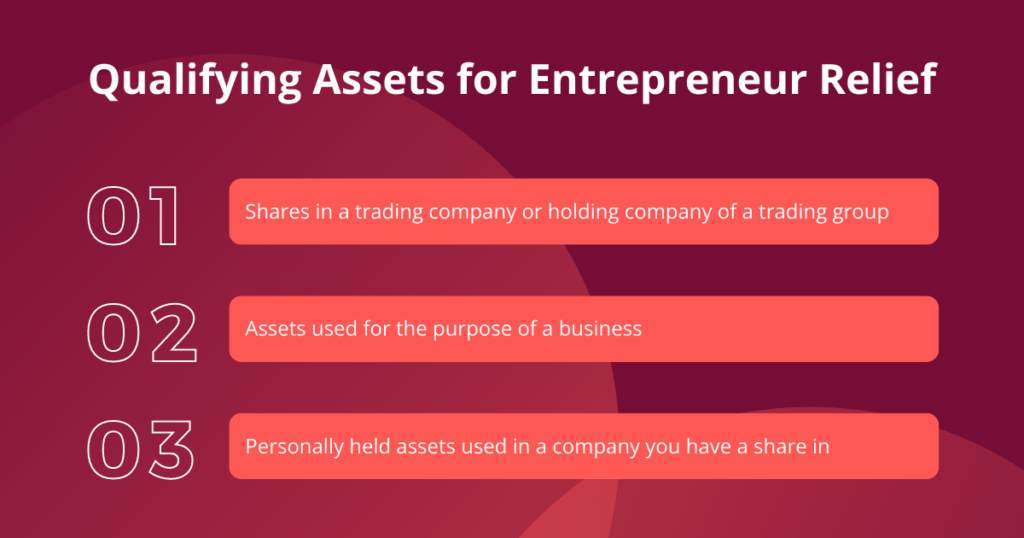
It can apply to a sole trader’s qualifying business assets or an individual’s shares in a qualifying trading company or holding company of a qualifying group. It is not a general discount on every investment an owner sells. Revenue explains the qualifying assets and conditions.
What is capital gains tax?
Capital Gains Tax, or CGT, taxes the gain when you sell or otherwise dispose of an asset. It does not normally tax the whole sale price.
For example, shares bought for €10,000 and sold for €50,000 on 10 October 2026 produce a €40,000 gain before allowable costs and other adjustments. At 31%, the tax would be €12,400 before losses, exemptions or reliefs. At 10%, the same qualifying gain would produce €4,000 of tax before those adjustments.
Both figures are illustrations. The cost of shares is not necessarily the same as all the money you have put into your company. A director’s loan, for example, is a separate item in the sale calculation.
How does entrepreneur relief work?
The 10% rate applies to the part of your qualifying gain that fits within your remaining lifetime allowance. For a qualifying share disposal from 7 October 2026, the standard 31% rate generally applies to the excess.
| Disposal period | Relief rate | Lifetime limit |
|---|---|---|
| 2016 | 20% | €1 million |
| 2017 to 2025 | 10% | €1 million |
| From 1 January 2026 | 10% | €1.5 million |
The increase does not give you a fresh €1.5 million allowance. Previous qualifying gains from 2016 onwards are relevant. For the transitional calculation, qualifying gains from 2016 to 2025 are brought into the aggregation up to the old €1 million cap. Revenue’s manual gives the worked rules.
If you used the full €1 million allowance before 2026, the higher limit can leave €500,000 available for a later qualifying disposal. Check your earlier returns before estimating your remaining relief.
What assets qualify for entrepreneur relief?
| What you are selling | Position to check |
|---|---|
| Ordinary shares in a trading company | Your holding, work and the company’s business must meet the conditions |
| Shares in a holding company | The company must hold a qualifying group, with the relevant trading and ownership conditions satisfied |
| Assets used in a sole trader’s qualifying business | The business use and ownership period must qualify |
| A personally owned asset used by your company | Excluded, even though the company uses it |
| Investments or development land | Excluded |
The distinction between a sole trader’s business asset and an asset you personally own outside your company matters. Owning a building that your company uses does not make that building eligible for this relief.
Investment activity, property letting and development also need attention. They should not be treated as qualifying trades just because they sit inside a business structure.
Who can apply for entrepreneur relief?
Individuals can claim it. Companies cannot claim this personal relief.
For a share sale, passive ownership is not enough. Your role and working time matter as well as your shares. For a sole trader, the assets must have been owned continuously for at least three years within the five years immediately before disposal and used in a qualifying business.
Why claim entrepreneur relief?
On a €1.5 million qualifying gain arising from 7 October 2026, with the full allowance available, the difference between 31% and 10% is €315,000 before other adjustments. That is enough to change what an exit delivers to you personally.
But planning around the limit alone can leave a gap. A €3 million gain does not become a €300,000 tax bill simply because the first €1.5 million qualifies. You need to model the excess and compare the relevant reliefs before the deal is fixed.
How to qualify
For company shares, separate these checks:
| Check | What the rule requires |
|---|---|
| Shareholding | At least 5% of the ordinary shares for a continuous three-year period at any time before disposal |
| Role and working time | Director or employee, spending at least 50% of working time in a managerial or technical capacity, for a continuous three years within the five years immediately before disposal |
| Business or group | A qualifying trading business or qualifying group |
Do not turn those into one vague instruction to be involved for three years. The timing is different. The post-2020 shareholding rule also means dilution below 5% is not, by itself, proof that relief has been lost if the required earlier holding period was satisfied. Funding rounds still deserve a review of the actual share history and other conditions.
For holding companies, check every subsidiary. Revenue’s guidance says a dormant or non-trading subsidiary can prevent the group from qualifying. The 51% subsidiary requirement is a group-ownership test, not a rule that 51% of your assets must be trading assets.
Connected-party sales need a separate review. Certain disposals of goodwill to a connected company, and shares where you remain connected afterwards, are excluded unless the commercial-purpose exception applies. A company buyback or restructuring is not automatically equivalent to an ordinary third-party sale.
Entrepreneur Relief and holding-company relief are different
There are two different sellers to consider:
- You sell your shares in a holding company. Revised Entrepreneur Relief may apply if you and the group qualify.
- Your holding company sells shares in a subsidiary. Section 626B may exempt the company’s gain, subject to its own shareholding, residence, trading and exclusion tests.
An exempt gain inside a holding company does not mean the proceeds can be taken out personally without tax. That second question needs its own calculation. Revenue’s Section 626B manual covers the company-level exemption.
What to review before a buyer arrives
Bring your share register, earlier relief claims, group chart and role history to the discussion. Ask for a calculation at your expected exit value and at a higher value. Include deferred payments, earn-outs and what you intend to do with the proceeds.
If a spouse is involved, assess their actual ownership and qualifying work separately. Marriage does not double your allowance automatically, and moving shares shortly before a sale does not create the required history.
How to claim
Claim the relief in the CGT section of the appropriate return for the disposal year. Keep the gain calculation and evidence supporting the qualifying conditions.
If you file Form 11, report the disposal there. If you do not normally submit an annual tax return, Form CG1 may be the appropriate route. PAYE status alone does not decide the form: follow Revenue’s return guidance.

How to calculate your entrepreneur relief amount
Suppose you sell qualifying shares for €2.2 million on 10 October 2026. Their allowable cost is €200,000, leaving a €2 million gain. You have not used the relief before.
| Calculation | Amount |
|---|---|
| First €1.5 million at 10% | €150,000 |
| Remaining €500,000 at 31% | €155,000 |
| Total with Entrepreneur Relief | €305,000 |
| Same €2 million gain at 31% | €620,000 |
| Difference | €315,000 |
This illustration excludes allowable losses, the annual exemption and transaction costs so the effect of the relief is clear. It is not a client case or a final tax computation. Our CGT annual exemption guide explains the separate €1,270 exemption.
If you already used €1 million of qualifying gains before 2026, the same sale would have only €500,000 of relief capacity left. On these assumptions, €50,000 at 10% plus €465,000 at 31% gives €515,000 before other adjustments. Earlier claims change the answer substantially.
When to claim entrepreneur relief?
The return and payment dates are different:
| Disposal date | CGT payment deadline |
|---|---|
| 1 January to 30 November | 15 December in that year |
| December | 31 January in the following year |
The CGT return is generally due by 31 October in the following year, including where relief means no tax is payable. For a written contract, the disposal date is usually the contract date. Do not assume the payment deadline follows the date the last instalment lands in your bank.
Revised entrepreneur relief
The revised scheme was introduced by Finance Act 2015 for disposals from 1 January 2016. The earlier Entrepreneur Relief applied to 2014 and 2015 and worked differently. The revised rate became 10% from 2017, and the lifetime limit increased to €1.5 million for disposals from 2026.
Start-Up Refunds for Entrepreneurs, or SURE, is another separate scheme. It concerns Income Tax relief on qualifying investment in a new company. A SURE claim is not proof that your eventual exit qualifies for CGT relief.
Need help claiming?
We look at exit tax as part of the wider plan: who is selling, what they own, which reliefs apply and how the proceeds will be used. Our tax accounting services explain that work.
If you run an Irish business turning over €250,000 or more and want your finances and tax planning to support a future exit, book a Finance Fit Call. We can discuss the support you need and agree the scope of any specialist transaction work.
FAQs
Both may be relevant to a disposal, but they have different conditions and calculations. They are not two discounts to stack on the same gain. Compare the applicable reliefs before choosing the claim.
It is a personal CGT relief that can reduce tax on qualifying business gains to 10%. For disposals from 2026, the lifetime limit is €1.5 million, with earlier qualifying disposals taken into account.
An earlier scheme applied to 2014 and 2015. Revised Entrepreneur Relief was introduced by Finance Act 2015 for disposals from 2016; its rate became 10% from 2017.
Yes, provided each disposal qualifies and you have remaining lifetime capacity. It is a lifetime limit across disposals, not an allowance for each sale.
No. The limit is measured against qualifying gains, not proceeds. Your allowable cost, earlier disposals and the qualifying conditions all affect the calculation.
It can, where the relevant conditions and Revenue’s treatment of trading up to liquidation are satisfied. A closure does not automatically qualify. Check the trade, timing and distribution before appointing a liquidator.
Still got questions? Let us know what you’re looking for.